

How to Receive International Payments in India
There are broadly four different ways to receive international payments in India, bank wires, payment gateways, remittance services, and virtual multicurrency accounts. Each one works differently when it comes to speed, fees, and compliance. Which one fits you comes down to what you actually want. Here’s a lowdown.Accept payment from 150+ countries
USD
Client pays
You'll receiveINR

Banks
PayPal
 RBI's PA-CB framework
Trusted by 50K+ users
 AICPA SOC2 certified
 ISO: 2022 Certified
Ways to Receive International Payments in India
Bank Wire Transfer (SWIFT)SWIFT transfer is the traditional banking route for receiving money from a client abroad, using your bank account number and SWIFT code. The sender’s bank routes the funds through the SWIFT network, often via multiple correspondent banks, before crediting your Indian account, and Indian banks typically apply a forex markup along the way, for example crediting you at ₹92/USD instead of the actual ₹94/USD.
Pros
Connects to virtually any bank globally, works for any currency pair
No eligibility checks or approval needed on the client’s end to send
Cons
1–3% worse forex rates vs mid-market
Possible intermediary bank deductions ($10–$40)
Slow settlement (3–7 business days)
Cost$15–50 sender/intermediary fees + FX markup + paperwork charges
Settlement Time3–7 business days
FIRANot automatic, request separately from your AD bank at an added cost
Ideal ForLarge transfers by established businesses prioritising safety
Bank Wire Transfer (SWIFT)SWIFT transfer is the traditional banking route for receiving money from a client abroad, using your bank account number and SWIFT code. The sender’s bank routes the funds through the SWIFT network, often via multiple correspondent banks, before crediting your Indian account, and Indian banks typically apply a forex markup along the way, for example crediting you at ₹92/USD instead of the actual ₹94/USD.
Pros
Connects to virtually any bank globally, works for any currency pair
No eligibility checks or approval needed on the client’s end to send
Cons
1–3% worse forex rates vs mid-market
Possible intermediary bank deductions ($10–$40)
Slow settlement (3–7 business days)
Cost$15–50 sender/intermediary fees + FX markup + paperwork charges
Settlement Time3–7 business days
FIRANot automatic, request separately from your AD bank at an added cost
Ideal ForLarge transfers by established businesses prioritising safety
International Payments to India: A Side-by-Side Comparison
Compare fees, settlement speed, compliance support, client experience, and more across leading international payment solutions.| Features |  |  |  | |
|---|---|---|---|---|
| Forex markup | 0% | 3-4% hidden | 2-4% hidden | 0% |
| Fee structure | 1.6-2% of transfer | 4.4% + fixed | $25-$50 + FX markup | Flat $19-$29 |
| Cost on $5,000 | $89 | $370 | $175 | $29 |
| Cost on $10,000 | $178 | $740 | $350 | $30 |
| Settlement speed | 1-2 business days | 2-5 business days | 3-5 business days | <24 hours |
| FIRA included | Manual request | Not available | Manual request | Auto, instant |
| Support | Email only | Email only | Slow & manual | Local Indian Support |
| Best for | Mid-size B2B | Small payments | Legacy bank users | B2B exporters |
How to Stay RBI Compliant While Receiving International Payments in India
To stay RBI compliant while receiving international payments in India, you need to declare the correct RBI purpose code on every inbound transfer and obtain a FIRA (Foreign Inward Remittance Advice) as proof of receipt, both are required under FEMA and form the basis of your GST filings and audit trail. P0802P0801
RBI Purpose Code
A purpose code is an alphanumeric code (e.g. P0802, P1401, P1301) that tells RBI why the money is coming in, salary, software export, gift, and so on. Every inbound remittance is required to carry one, and banks capture it for FEMA reporting. Getting it right matters: the wrong code can delay or return a payment, and it’s what keeps your GST filings and audit trail consistent. A freelancer exporting IT services, for example, would use P0802 (Software Services). Share the code with your sender before they initiate the transfer, most platforms let you enter it directly.FIRC/FIRA
Once the money lands, your bank issues a Foreign Inward Remittance Advice (FIRA), still often called FIRC, showing the sender’s details, the amount, and the purpose. It’s essential for accounting, GST claims, and export incentives. Traditional banks charge for it (Axis Bank, for instance, ~₹250) and may ask for invoices, contracts, or Form 15CA/15CB before issuing it. Digital platforms like Skydo and Payoneer skip this entirely, generating an electronic FIRA instantly at no extra charge. Either way, hold onto every FIRC/FIRA, you’ll need it for GST and audit purposes.Auto-Generated FIRA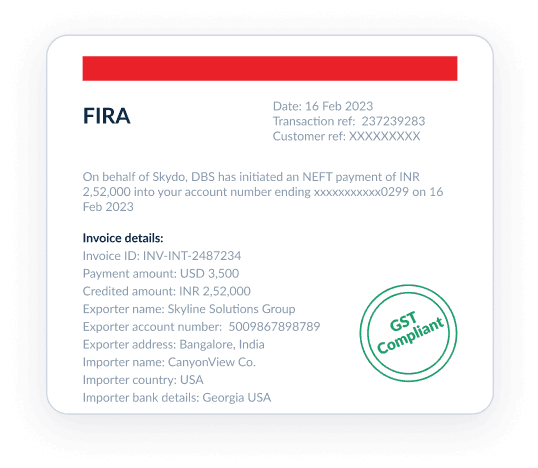
Choosing the right method to receive payments only solves half the problem, staying compliant on every transfer is what keeps it problem-free.
Six Factors to Consider While Receiving Money from Abroad
Choosing the wrong payment method doesn’t just cost money, it can slow down settlements, complicate compliance, and create friction for your clients. Here are the six factors to compare.Total Cost, Not Sticker FeeBanks hide 2-4% FX markup. Compare INR received, not stated fees.
Look forMid-market rates + flat pricing
Settlement Speed3-5 business day settlements can slow down your cash flow.
Look for<24h to your Indian bank
FIRA & ComplianceManual FIRA requests and extra certificate fees can quickly add up.
Look forAuto-issued FIRA per payment
Client ExperienceComplicated payment flows can slow down collections.
Look forLocal accounts in client countries
Country CoverageLimited country coverage can make collections significantly harder.
Look forCoverage in your top 3 markets
Support QualitySlow, email-only global support can delay critical payment issues.
Look forIndia-based phone & WhatsApp
Why Choose Skydo to Receive International Payments in India
Skydo gives you the live mid-market rate with zero markup, flat transparent fees, RBI-backed security, and instant FIRA on every transfer, everything an Indian exporter needs to get paid without extra cost or delay.Receive Payments from15+ countries
RBI authorized and ISO 27001
24-hour settlement. India-based support
Live mid-market rateSame rate you see on Google, every time.
Flat fees
Under $2,000$19
$2,001-$10,000$29
Above $10,0000.3%
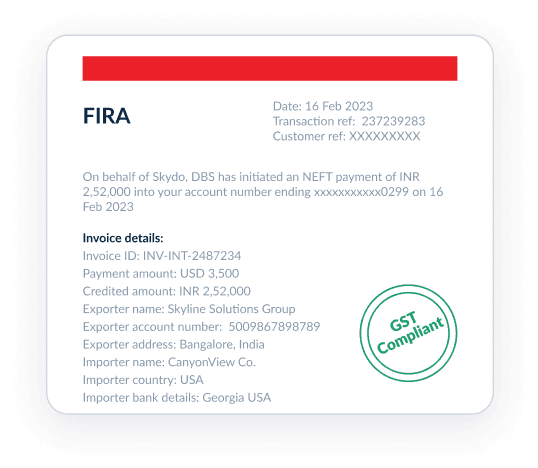
Instant & free FIRA,
every time.FIRA lands instantly in your inbox. Or download it anytime from your dashboard
every time.FIRA lands instantly in your inbox. Or download it anytime from your dashboard
Watch How Skydo Helps to Receive International Payments
From signing up to receiving your first international payment, here is exactly what the experience looks like.Here’s what Skydo users have to say
See how Indian businesses get paid by US clients on Skydo, from sharing account details to INR landing in the bank, in one short walkthrough.

Receive Money from 40+ Countries
 Receive Money from United States
 Receive Money from United Arab Emirates
 Receive Money from United Kingdom
 Receive Money from Argentina
 Receive Money from Australia
 Receive Money from Austria


Frequently asked questions
What is the cheapest way to receive international payments in India?
For business payments, Skydo offers the lowest total cost with flat fees ($19-$29) and zero forex markup. Always compare the total INR received, not just the stated fee. Banks typically hide 2-4% in forex markup that never appears as a line item on your statement.
How long does it take to receive international payments in India?
Via Skydo’s local accounts (ACH, Faster Payments, SEPA): under 24 hours. Via traditional SWIFT wire through a bank: 3-7 business days. Skydo uses local payment rails in each country, which settle much faster than the correspondent banking network.
Do I need GST registration to receive international payments in India?
If you export services commercially (freelancing, IT services, consulting), GST registration is mandatory. You charge 0% GST on export invoices with a Letter of Undertaking (LUT). If you receive personal remittances from family abroad, GST registration is not required.
What is FIRA and why is it important for receiving foreign payments?
FIRA (Foreign Inward Remittance Advice) is your official proof that foreign currency was received in India. You need it for income tax filing, GST returns, eBRC closure, and export incentive claims. Banks take 7-14 days and charge fees. Skydo generates FIRA instantly for every payment at no extra cost.
Is there a limit on receiving international payments in India?
There is no upper limit on inward remittances for business purposes under FEMA regulations. You can receive any amount as long as the purpose is legitimate and documented with the correct purpose code. Personal remittances also have no cap on the receiving side.
What are the charges for receiving international payments in India?
Charges vary by method. Banks charge 2-4% hidden forex markup plus wire fees. PayPal charges 4.4% plus 3-4% forex markup. Wise charges ~1.5% conversion fee. Skydo charges a flat $19-$29 with zero forex markup, making it the lowest cost option for business payments.
Which countries can send payments to India via Skydo?
Skydo supports payments from 150+ countries. For USA, UK, Canada, Australia, UAE, Germany, Singapore, and Nigeria, your client pays via local bank transfer. For all other countries including Malaysia, China, and Japan, clients send SWIFT payments to Skydo’s International SWIFT Transfer Account in the UK.
How do I receive international payments in India without losing money on forex?
Use a platform like Skydo that converts at the live mid-market exchange rate with zero markup. Banks and PayPal embed 2-4% hidden markup in their exchange rates. On a $10,000 payment, this difference alone can save you over ₹70,000 compared to traditional banking channels.
What documents are required to receive international payments in India?
You need PAN card, bank account details, Aadhaar, GST certificate (if registered), and an invoice to sign up for the first time. Skydo handles all RBI compliance documentation including purpose code tagging and FIRA generation. Your international client only needs your local account details to initiate the payment.
Is Skydo safe and authorized for receiving international payments in India?
Yes. Skydo is authorized by the Reserve Bank of India under the PA-CB (Payment Aggregator Cross Border) framework. Skydo is SOC 2 certified, ISO 27001 certified, and partners with HDFC Bank, DBS, Visa, and CurrencyCloud. Over 30,000 Indian businesses use Skydo to receive international payments.